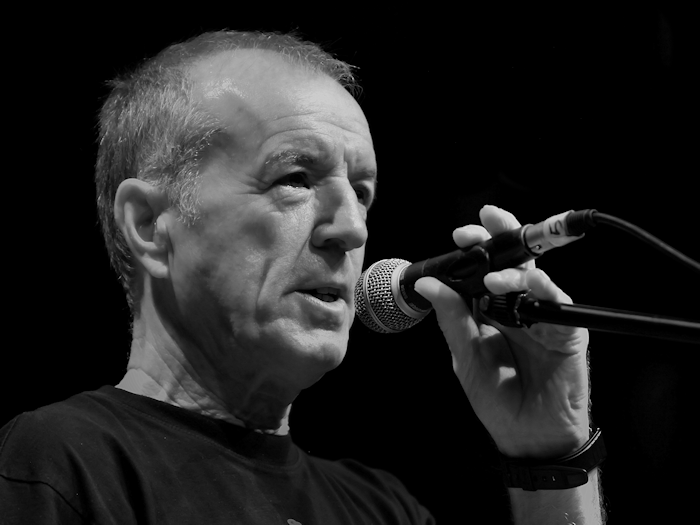
Albert Lee: The Man Behind the Masters
Six decades on the road. Emmylou Harris. Eric Clapton. The Everly Brothers. Eddie Van Halen. Albert Lee has been the first call for the greatest names in popular music — and the best reason you’ve never quite heard of him is that he was always too busy making everyone else sound better.
There’s a particular moment in any conversation with Albert Lee where the scale of what he’s witnessed begins to properly land. It might be the casual mention of recording sessions at which Eric Clapton happened to be present. Or the recollection of driving from Los Angeles to Nashville with The Crickets — three days on the road, America unspooling through the windscreen — to cut an album in a city he’d previously only known through records. Or the story of Eddie Van Halen, one of the most technically formidable guitarists of the twentieth century, nervously confessing that he didn’t think he could play country.
“I said, ‘Yes you can. Just do what you do,’” Lee recalls, with the unhurried ease of a man for whom sharing a stage with Van Halen was simply another Tuesday.
Albert Lee has spent sixty years being exactly that kind of guitarist — the one other guitarists call when they need someone who can do things they can’t. The one who makes a band better the moment he walks in. The one who earns the description “guitarist’s guitarist” not as consolation prize but as the highest possible compliment the form allows.
South London to the Fingerboard
He came to guitar sideways. Growing up in South London, piano came first — until the lessons stalled, the practice dried up, and his teacher delivered a frank assessment to his parents. “They said, ‘You’re wasting your money. He’s not practising.’” Then Lonnie Donegan came through a radio speaker and everything shifted. “Boy, this is exciting,” thought the teenage Lee, and that was that.
For eighteen months he played without owning an instrument, borrowing guitars from school friends and teaching himself by ear — dropping the needle on records, lifting the arm, dropping it again, trying to hear what was happening inside the sound. It was slow, physical, intimate work that would prove formative. “I’d hear a solo and I’d put my own bits in it. That’s how I really learned my way around the fingerboard.”
His early heroes were telling. While contemporaries gravitated towards Chuck Berry’s one-position economy, Lee found himself drawn to Cliff Gallup — Gene Vincent’s guitarist, older than the rock and roll pack, melodic where others were rhythmic, using the whole neck where others stayed rooted. Gallup played like someone who’d listened carefully to jazz and country before rock and roll arrived to reorganise everyone’s priorities. So, as it would turn out, did Albert Lee.
By 1960, still a teenager, he was on the road with a twenty-watt amp and a borrowed Grazioso — the Futurama copy that fooled him into thinking he had something close to a Stratocaster. He didn’t. But it didn’t matter. He was playing.
Fifty Pounds and a Telecaster
The instrument that would define him cost fifty pounds, second-hand, in 1963. At the time, Telecasters were unfashionable in Britain — everyone wanted a Stratocaster, like Hank Marvin, like Buddy Holly. The Telecaster was considered the inferior option. Lee bought one anyway and fell immediately, permanently in love.
“It totally changed my life. I love that bright, wiry sound. It makes you play a certain way.”
It made him play his way — which was already diverging from the blues-drenched direction that would come to dominate British guitar culture in the mid-’60s. When Eric Clapton was reinventing the vocabulary of electric guitar through the prism of American blues, Lee was listening to George Jones records and backing country bands at American military bases around London for twenty pounds a week. “In England, everybody wants to play soft rock and blues,” he notes, without bitterness. “I wanted to play something else.”
That something else — country music, its melodic sophistication and rhythmic precision, its fundamental commitment to serving the song — would eventually take him further than the blues ever could.
The Guitar Eric Clapton Never Asked Back
In the early ’60s, Lee joined a band under circumstances that had less to do with musical compatibility than with a guitar case left open at the right moment. “He opened up this case, showed me this Les Paul Custom,” he says of the encounter. “I said, ‘I’ll join your band.’” He took over the payments, loved the guitar, and eventually — regrettably, he would later come to feel — sold it.
Years later, by which point he was playing alongside Eric Clapton, he mentioned the sale in passing.
“‘Oh, I’ve got one of those at home somewhere,’ Clapton said.” The guitar appeared at the next session. Lee started using it on the road. Clapton never asked for it back. “He does acknowledge in his book that he gave me the guitar,” Lee notes, with characteristic precision.
It’s a small story. But it captures something essential about the circles Albert Lee has moved in for sixty years — the casual proximity to greatness, the mutual respect between serious musicians, the way important objects pass between hands as naturally as musical ideas.
Nashville, Emmylou, and the Call That Changed Everything
When Heads, Hands and Feet — the eclectic band Lee co-led in the early ’70s — finally dissolved, he found himself at a crossroads. He was in Los Angeles. He was thinking about returning to England. He wasn’t sure what came next.
What came next was Emmylou Harris — or more precisely, the absence of James Burton. Burton had been Harris’s guitarist until Elvis Presley’s organisation called. Someone needed to fill the chair. The call came to Lee. “I did some gigs with her and they decided to keep me.”
He stayed. He found an apartment in Malibu, overlooking the ocean. “I thought, ‘Well, I guess I’m living here now.’”
The Hot Band was one of the finest touring units in American music — disciplined, emotionally precise, capable of making country music feel like the most sophisticated thing in the world. Lee thrived in it. When he eventually moved on, it was to Eric Clapton’s band — five years, arena shows, fifteen thousand people a night.
“He fired the whole band a couple of times,” Lee recalls of his tenure with Clapton. “I managed to survive.” The experience sharpened something in him. “I thought, ‘Well, this isn’t gonna last forever.’ You just never know.”
Twenty Years with the Everlys
The chapter that would most publicly define his reputation began at the Royal Albert Hall in 1983, when Don and Phil Everly buried a decade of estrangement and walked back onstage together. Lee was their guitarist. He would remain so for over twenty years.
He had loved the Everly Brothers since childhood — their harmonies, their economy, the way their records felt like distillations of everything essential in American popular music. Playing behind them every night, he never lost that original feeling.
“Boy, these guys sound great,” he’d think, standing a few feet away from one of the great vocal partnerships in music history. “I said, ‘Just being behind them.’”
Holding His Own
Ask Albert Lee about his place in the guitar world and he’ll deflect. Ask him about the sessions with Steve Morse and Steve Lukather and Van Halen, and he’ll eventually concede something.
“It taught me a lesson. If I can hold my own with those guys, I should have plenty of confidence. What I was doing was different to what they were all doing.”
Different. That word matters. Albert Lee never tried to be the loudest or the fastest or the most technically overwhelming guitarist in the room. He tried to be the most musical. In doing so, he became something rarer and more durable — the guitarist that other great guitarists most want to play with.
When people call him a legend, he offers the response that has become something of a signature. “You get to be a legend by just getting older and still being around.”
He says it like a joke. He means it as a joke. But it lands differently once you understand what “still being around” has actually looked like for Albert Lee — the sessions, the stages, the names, the decades of quiet, unshowy, deeply serious commitment to the art of the guitar.
Still on the road. Still the first call. Still, at heart, the kid who spent eighteen months borrowing other people’s guitars, learning by ear, putting his own bits in.
Albert Lee was interviewed at Barnoldswick Music & Arts Centre ahead of his performance at the venue.